
Commercial and Industrial Driveway Paving in Midland-Odessa, TX
The driveway is where a public road meets private property, and it takes a kind of punishment that the rest of the pavement never sees. Every truck, trailer, and delivery van slows, turns, and loads its weight through the same few feet of asphalt, and the road itself sends water, sand, and debris straight into that spot.
Danny’s Asphalt Paving builds commercial and industrial driveway paving across Midland-Odessa and the wider Permian Basin: driveways, approach ways, building aprons, and the loading and parking areas that connect to them, all built for trucks and equipment instead of passenger cars alone.
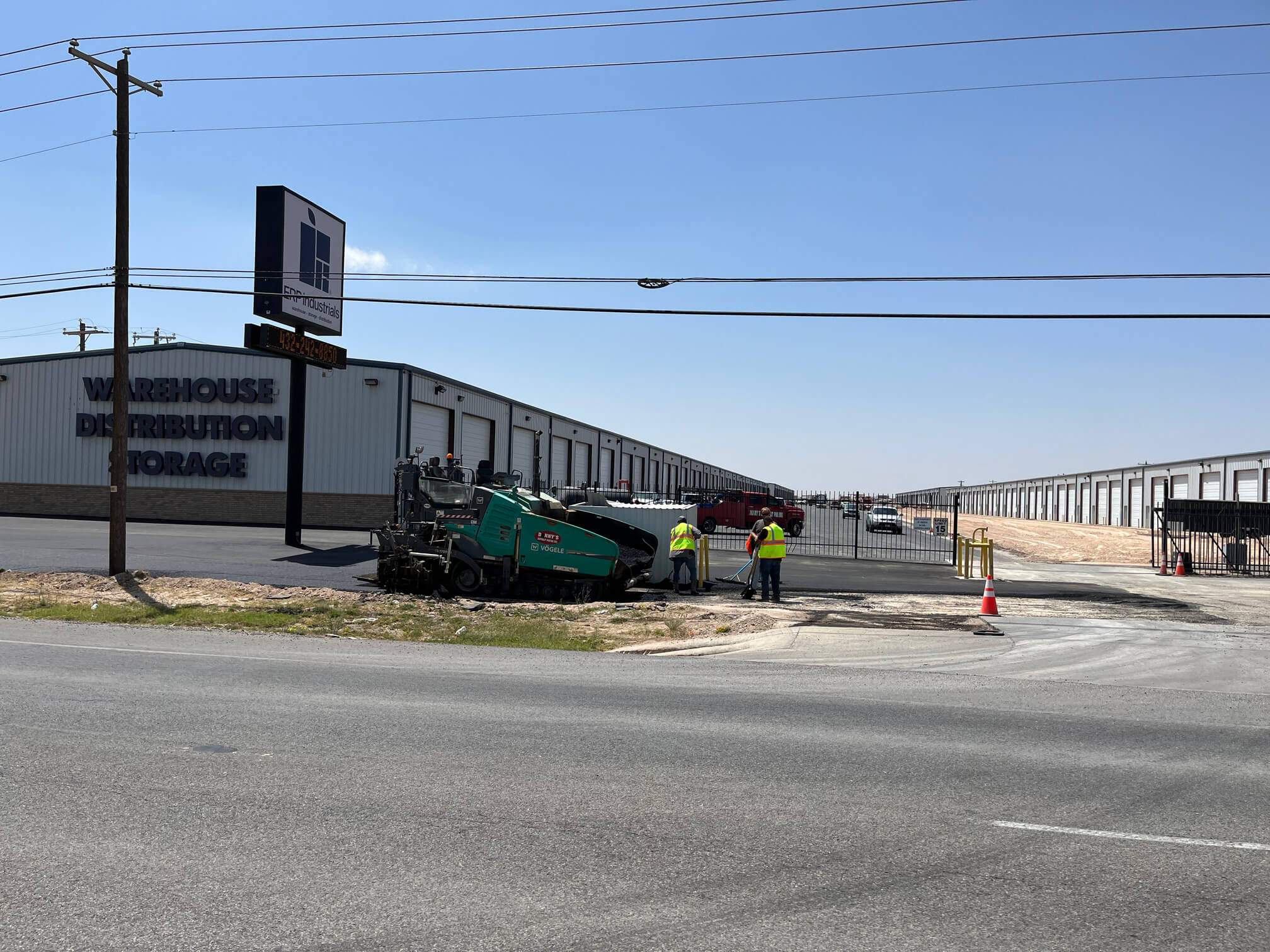
What Commercial and Industrial Driveway Paving Covers
A commercial driveway is not a wider version of a home driveway. It has to carry gross vehicle weights that a residential surface is never designed for, and it has to manage the transition between the public road and the property without breaking apart at the edge.
When that entrance is built too light, the failures follow a pattern: the edge crumbles where tires cross the curb line, ruts form in the turning path, and the dip or bump at the road transition starts scraping trailers. Each of these gets worse every time a loaded truck passes.
This service fits any property that depends on vehicles getting in and out: shops, yards, plants, distribution sites, service companies, and multi-tenant properties with a shared entrance.
What We Build
- Commercial and Industrial Driveways: The main entrance and any secondary entrances, sized for the largest vehicle that will use them.
- Approach Ways: The connection between the public road and your driveway, where grade, drainage, and tie-in to the existing road surface decide how long the entrance lasts.
- Building Aprons: The paved area at overhead doors and building entrances, where trucks maneuver and park close to the structure. Where an apron needs concrete elements such as curbs, gutters, or dumpster pads, our concrete work crews handle them as part of the same project.
- Loading and Parking Areas: The paved zones tied to the driveway, laid out so trucks and customer vehicles do not fight over the same space.
How We Build a Commercial Driveway
- Walk the entrance and the road. We check the turning path of your largest vehicle, the slope of the ground, and who maintains the road you connect to. That last detail decides who has to approve the work.
- Confirm approvals and utilities. A driveway that connects to a state highway needs a TxDOT driveway permit, and no work inside the right of way can begin until that permit is issued. Underground utilities are located before any digging starts.
- Excavate to firm subgrade. Soft or disturbed ground under an entrance is what turns into a rut later, so we cut down to material that will hold.
- Build the base in compacted layers. Strength comes from the stone and soil under the asphalt, not from the asphalt itself. Our base work is compacted in layers so heavy wheels cannot push it sideways.
- Set the grade. The entrance is shaped so water runs away from the road and the building. Corner radii are kept inside the property frontage, as TxDOT requires on state highway connections.
- Place and roll the hot mix. Asphalt from our own plant is delivered hot, spread, and rolled before it cools, because density achieved during that window is what resists rutting.
- Finish the edges and tie-ins. The seam against the existing road and the outer edges get the most attention, since that is where most entrances start to fail.
- Mark and hand over. Striping and directional markings go down once the surface is ready, and we tell you when trucks can use it.
Warning Signs Your Entrance Needs Work
- Broken, crumbling edges where tires cross the curb line or road edge
- Ruts or ripples in the path trucks take when they turn in
- A drop, bump, or gap where the driveway meets the public road
- Water running from the street onto your property, or pooling at the entrance
- Gravel or caliche tracked onto the road from a worn-out surface
- Cracks that run across the full width of the entrance instead of along it
Timing a Driveway Project
West Texas allows a long paving season because winters are mild, but heat still matters. Hot mix needs to be placed and compacted while it is hot enough to work, and a surface that is too fresh should not take loaded trucks until it has cooled and set. We plan the sequence around temperature and tell you when the entrance is ready.
The bigger scheduling issue is access. Closing the only driveway cuts a site off from deliveries, so we plan the work in halves, or around a temporary alternate entrance, whenever the property layout allows it. After the work, check entrances at the end of summer and again before the cooler months, since they wear faster than the rest of the pavement.
Why Property Owners Choose Danny’s Asphalt Paving
- Plant-to-Driveway Control: The mix we lay is produced by Basin Asphalt, so the product arriving at your entrance comes from a plant we know and control.
- A Fleet Built for Heavy Work: Our own equipment and trained crews handle excavation, base, paving, and rolling, which keeps the job moving and the entrance closed for less time.
- Fully Licensed and Insured: Compliance is in place before a crew arrives on site.
- Local Since 1990: We have paved entrances, aprons, and loading areas for commercial and industrial properties across the Permian Basin for decades.
Where We Offer Commercial and Industrial Driveway Paving
We build commercial and industrial driveways across the Permian Basin and West Texas, including Midland, Odessa, Andrews, Big Spring, Big Lake, Colorado City, Fort Stockton, Fort Davis, Kermit, Lubbock, Ozona, Rankin, Van Horn, Alpine, and Stanton. See every community on our areas served page.
Driveway Paving Questions From Property Owners
What is the difference between a driveway, an approach way, and a building apron?
The driveway is the paved path from the road to your property. The approach way is the section where that path meets the public road. The apron is the paved area next to the building or its overhead doors. Each takes different loads, so each is built a little differently.
Do I need a permit to pave a commercial driveway?
It depends on who maintains the road you connect to. A driveway onto a state highway requires a TxDOT permit before any work in the right of way begins. City and county roads have their own approval processes. We confirm this during the site visit so the work does not stall later.
What affects the cost of a commercial driveway?
Size, the condition of the existing ground, how much base work is needed, the vehicles that will use it, drainage requirements, and how easily our equipment can reach the site. We provide a written estimate after seeing the property.
Can you pave a driveway without shutting down my site?
Often, yes. We can phase the work in sections or plan around a temporary entrance so deliveries and employees keep moving.
How soon can trucks use a new driveway?
That depends on the temperature, the thickness of the asphalt, and the loads involved. Hot mix needs to cool and set before it carries heavy vehicles, and we tell you when it is ready rather than guessing.
Who builds commercial and industrial driveways in Midland-Odessa, TX?
Danny’s Asphalt Paving has built driveways, approach ways, building aprons, and loading areas for commercial and industrial properties across Midland-Odessa and the Permian Basin since 1990.
Request a Free Estimate for Your Driveway Project
Tell us about your entrance and the vehicles that use it, and we will schedule a site visit. Phone (432) 563-1240 to book a walk-through, or stop by 12820 E. Highway 191 Frontage Rd., Midland-Odessa, Texas 79707.
Take the First Step to Excellence!
Start Today with Our Expert Paving and Construction Services for Unmatched Results.
Schedule your FREE estimate for an upcoming project or contact us if you have further questions.